
Pakistan Is Growing – But Not Healthier

The jug cannot be filled beyond its capacity if fill further will lead to spillage, overpopulation does the same. Pakistan is growing – faster than almost any other country in the world – but this growth is far from healthy. As per 2025 survey the population of Pakistan is 247.7 million, and expected to exceed 257 million by 2050. Yet, while the numbers are rising, the health, well-being and dignity of people, especially women and children, are being worryingly neglected. Population growth is often considered a statistic, but in Pakistan it is a humanitarian crisis, reflecting poor governance, weak health systems and deep social inequalities.
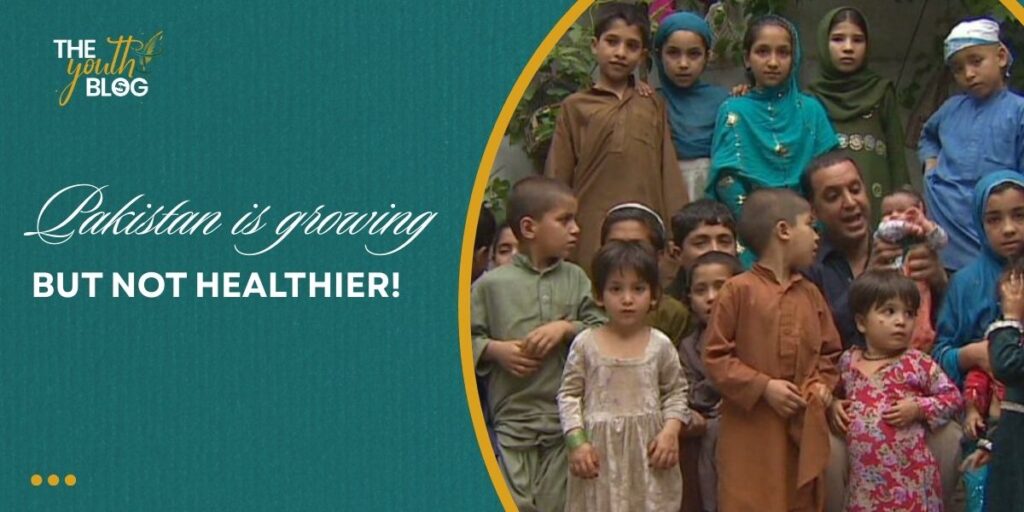
Population Growth: The Situation At A Glance
Every day, an estimated 27 women die from pregnancy-related complications and 675 newborns die from preventable causes. This means that approximately 10,000 mothers and more than 246,000 infants die each year. These deaths are not a matter of fate; they are the result of a health system in Pakistan that cannot cope with population pressure, a government that struggles to implement policies, and social norms that deprive women of control over their bodies.
Women At The Centre of the Population Crisis
Women’s rights are at the root of this crisis. In rural areas, women often lack autonomy over reproductive decisions and are culturally or socially prevented from seeking health care. Family planning remains a sensitive topic in regard to religion discourse, and misinformation or stigma discourages contraceptive use. Women face life-threatening complications due to unsafe abortion, limited access to maternal care, and gender inequalities. It is impossible to address population growth or public health without empowering women to make informed choices about their health and their families.
Read More: Women’s Rights? A mere joke!
A Governance Issue
Poor governance exacerbates these challenges. Pakistan’s health sector remains underfunded, weakly monitored, and fragmented in policy implementation. Clinics meant to provide basic care often lack
trained staff, essential medicines, or functional equipment. In rural areas, one doctor serves around 2,500 people, compared to one per 1,000 in urban Centre’s. Absenteeism frequently leaves rural health facilities closed, depriving communities of basic support. Even ambitious maternal and family planning initiatives fail due to poor coordination between federal and provincial authorities. Policy without implementation is meaningless when lives are at stake.
Secondary Challenges Stemming From Overpopulation
In poor and farming families, children are often seen as contributors to household work or as security for parents in old age. Meanwhile, weak governance extends beyond health: trafficking and illicit trade drain resources that could finance hospitals and clinics. Every rupee lost to smuggling is a lost opportunity to save lives or improve services.
Pakistan’s demographic growth can become an asset, but only if the country strengthens governance, invests in health infrastructure and empowers women. Development without health, without dignity, without rights is not progress.
References
Pakistan’s rapid population growth places increasing pressure on already strained public services
(Dawn, 2025; Pakistan Today, 2025).
As one of the world’s most populous countries, Pakistan continues to struggle with translating
demographic growth into human development (UNFPA, 2025).
Women and children bear the heaviest cost of this imbalance, particularly in maternal and
reproductive health outcomes (United Nations Pakistan, 2025).
Every day, preventable pregnancy-related complications claim the lives of dozens of women,
reflecting deep structural failures in healthcare delivery (World Health Organization
[WHO], 2025).
Family planning remains a sensitive issue in many communities, where misinformation, stigma,
and selective religious interpretations discourage contraceptive use (UNFPA, 2025).
Poor governance further exacerbates these challenges, as chronic underfunding and weak
monitoring undermine health service delivery (Pakistan Bureau of Statistics [PBS],
2025; The Nation, 2025).
Healthcare access remains deeply unequal, with severe shortages of doctors and frequent
absenteeism in rural facilities (The Friday Times, 2025).
Governance failures extend beyond health, as persistent smuggling networks expose policy gaps
and enforcement weaknesses that drain state capacity (Federal Board of Revenue [FBR],
2025; Business Recorder, 2025).
Ultimately, ambitious policies without effective implementation continue to cost lives and erode
public trust (WHO, 2025; UNFPA, 2025).
Political Science Graduate from International Islamic University Islamabad (IIUI
Amazing content! Looking forward to more blogs like this.I learned something new today. Such a great blog
Great work!
Need more blogs to create awareness.
Completely agree. Development without better health is neither sustainable nor meaningful.
A wonderful blog highlighting the concerns about one of the most neglected issues in Pakistan.
Commendable work. Population awareness is essential for a better and sustainable future👍