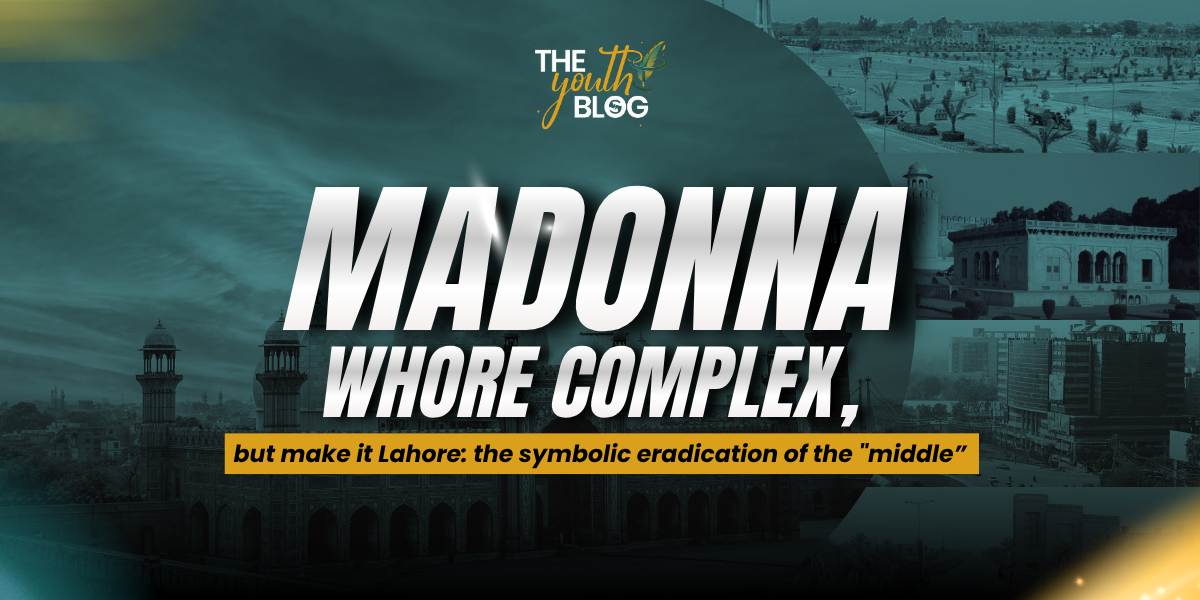
Madonna–whore Complex, but Make it Lahore: the Symbolic Eradication of the “Middle”

The city with a split personality
Lahore has been undergoing a serious identity crisis. Not because the city lacks one, but because we refuse to let it have more than two. A city this sprawling and contradictory gets flattened into two exaggerated images at opposite ends of a spectrum, while everything in between fades into the background.
On one end there is the aesthetic-ization of a polished, curated Lahore: Raya fairways, golden-hour lighting, trimmed lawns, and just enough minimalist cafés for your next coffee photo dump. Clean, controlled, desirable. Then there’s our widely celebrated “androon”: ageing brickwork, tangled wires, weathered balconies, a version of the city endlessly romanticized for its “authenticity.” A culturally richer but economically poorer side of Lahore that increasingly survives on our aesthetic obsession with it. We love photographing its decay far more than confronting the conditions that produced it. Heritage becomes beautiful the moment someone else has to live inside it.
Where’s My Johar Town Edit?
Somewhere between Raya and Androon, the rest of Lahore simply… disappears. Where are the reels about Gulberg as a lived, ordinary neighborhood, not just a café strip? Where is Garden Town on your feed as anything other than a passing location tag? What about Johar Town, where the majority of Lahoris actually live unremarkably real lives? The middle is denied the potential
to become aspirational when you aestheticize everything apart from it.
Read More: The Addiction We Don’t Admit: Social Media’s Grip on Us
Wife Material vs. “For the Streets”: A City Edition
The systematic elimination of the ordinary middle-class lifestyle from the sphere of aesthetic representation is a quiet eradication of the middle class itself on a larger political scale. Sounds like a stretch? Stay with me. The moment we repeatedly refuse to represent the middle, despite it making up most of the city, we stop treating it as worthy of attention altogether. And that refusal eerily mirrors another binary we’ve been imposing for centuries: the way we imagine women.
Welcome to the Madonna–whore complex: humanity’s bizarre inability to let women be boringly, gloriously complicated. She’s either the woman you marry or the woman you judge, put on a pedestal or pushed off one. We treat cities exactly the same way. We don’t let Lahore simply be a city; we force it into archetypes: pristine or authentic, elite or historic. Just as a woman is
labelled “wife material” or “for the streets,” a city is either “the real Lahore” or “the modern Lahore.” Complexity is traded for categories because categories are easier to consume. Flattening women into symbols and flattening cities into aesthetics comes from the same impulse: we are far more comfortable with caricatures than with reality.
The Fun Little Treats of Capitalism
All this talk about split city identities eventually leads to the real villain of the story: capitalism. In today’s hyper-capitalist world, the middle has become an inconvenience. Capitalism sells you the dream of becoming rich, but it also needs people who never quite make it; the engine cannot function without the poor. An impoverished class doesn’t sound aspirational, so it gets repackaged through branding: warm lighting, vintage filters, poetic captions, until deprivation starts looking like an aesthetic. The fantasy of upward mobility only works if someone is left below to make climbing feel meaningful. Meanwhile, the middle just ruins the plot, so it quietly disappears symbolically first, before it’s gone for good economically.
The middle becomes invisible precisely because it resists spectacle. Social media thrives on contrast because extremes perform better. A manicured lawn or a crumbling haveli both tell cleaner stories than a two-story house in your local muhalla with a Suzuki parked outside. Algorithms reward exaggeration instead of normalcy, and so the visual culture of Lahore becomes polarized, pushed into a binary it does not actually inhabit. It is not just elite enclaves and historic chaos; it is also the mundane, the repetitive, the in-between. The Madonna–whore complex, when mapped onto a city, reveals less about the places themselves and more about the gaze that constructs them.
Capitalism survives by manufacturing dissatisfaction, by making you feel your neighborhood is not “Pinteresty” enough to be worthy of capturing. The ordinary must feel chronically insufficient, so you pine for either commodity: a luxury neighborhood symbolic of wealth, or a heritage district packaged as cultural capital. The middle fades into the background because there’s not much to monetize there. It’s too stable to evoke charity and too familiar to be exotic.
Why should you care?
The result is just as much psychological as it is economic. The middle is subtly taught that existing as it is can never be enough: one must either climb relentlessly toward the elite or fear falling toward poverty. Remaining where one is becomes narratively impossible; the middle is transformed into a waiting room rather than a destination.
So congratulations. You’ve successfully learned that your neighborhood isn’t aesthetic enough, your house isn’t old enough to be heritage or new enough to be luxury, and that your life could use better branding. No wonder we’re exhausted. The point isn’t that you should stop wanting a nicer house or a better salary; ambition isn’t the villain here. The problem begins when ordinary life starts feeling like a draft instead of the real thing, when every scroll convinces you that you’re permanently in the “before” photo of somebody else’s success story.
So why make such a big deal over a few Instagram reels and some neighborhoods that don’t get enough screen time? Because representation has consequences. Spend enough time consuming a city through its extremes, and the ordinary begins to feel like failure. Suddenly your neighborhood isn’t home anymore; it’s somewhere you’re supposed to outgrow. Wanting more is human, but capitalism’s trick is convincing you that what you already have was never worth wanting in the first place.
Let’s Wrap It Up
So this isn’t really an article about Raya, or Androon, or even Lahore. It’s about what happens when reality loses a beauty contest against fantasy, when every scroll teaches us that life only becomes meaningful once it looks exceptional. Which is a shame, because most of life happens in the middle, and if we keep editing the middle out of our cities, sooner or later we’ll start
editing it out of ourselves too.
Perhaps the real question is not why Lahore is represented through extremes, but why we seem incapable of loving anything that refuses to be extraordinary. Because the middle is where reality lives. And reality has never been as marketable as fantasy.
About The Author:
Navigating existential experience on earth as a mildly disappointed optimist. Discussions on religion, politics and gender excite me. This blog is my constant stream of consciousness as a non-linear associative thinker which entails an intersectional analysis of the society around me, from purely my perspective. I hope you have as much fun reading it as I had writing it.