
Beyond a Signature: The Disregarded Four-Page Document in Pakistan

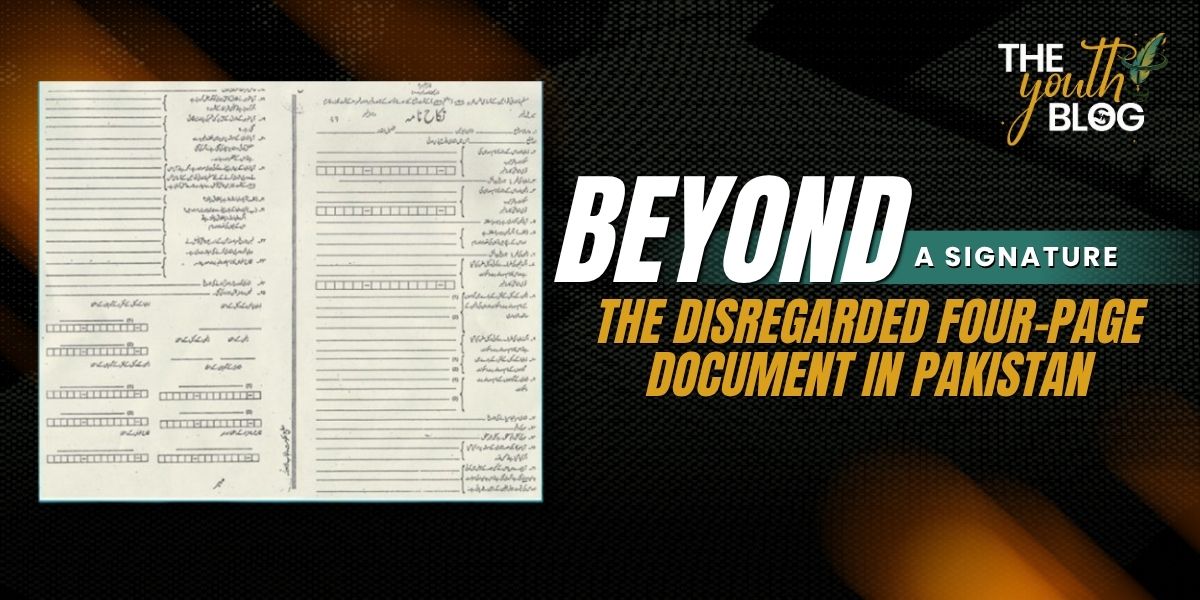
As a girl in Pakistan, when we are encouraged to think about marriage, our minds turn towards bridal lehenga, mehndi designs, soft-glam makeup, and décor straight out of Pinterest-inspired mood boards. Yet nobody sits us down and says, “Beta, before you worry about your wedding look, you must worry about Nikkahnama (marriage contract).” Yet apart from the sparkly wedding dresses and extravagant wedding festivities, the unglamorous and boring-looking Nikkahnama document is arguably the most important piece of paper a woman will ever sign.
Like many people, I grew up thinking that Nikkahnama was just a formality and proof of marriage, I later realized how important it is for a bride’s security across all domains. Nikkahnama determines whether a woman spends her marriage with substantive rights or takes a gamble by relying on how generous her husband turns out to be. Here is why every girl needs to read her Nikkahnama and break the custom of crossing clauses that could actually protect her.
Column 18: An Overlooked Yet Powerful Clause
Going into the nitty-gritty of the Nikkahnama, you will find column 18. If your husband agrees and it is marked as “yes,” then you are granted the right of “Talaq-e-Tafweez.” It is a legally assured right for a woman to seek divorce. In simple terms, if the marriage falls apart, you can legally end the marriage, while your financial rights stay intact. Imagine preventing countless court visits just to beg a judge for khula (a woman’s legal right to initiate divorce from her husband) and often losing haq mehar (a gift given to the bride by the groom under Islamic law).
Granting such provisions for marriage might seem like a feminist add-on that a lawyer has invented, but in reality, it comes under Islamic jurisprudence. It is also legally recognized in the Muslim Family Laws Ordinance, 1961. Ironically, the same guardians of Islam find it overbearing. Similarly, an overwhelming majority of Pakistani Nikkahnamas cross out column 18 or leave it blank. It is not because women don’t want it, rather they are not told that this column exists, not even by the nikkah registrars. Even in our patriarchal culture, the groom and his family often see this initiation as an insult and threat to a man’s dignity.
An Overlooked Financial Contract: Haq Mehar Is Not Just a Wedding Gift
As families decide on the haq mehar, it is often reduced to “the amount of gold the bride will receive from her in-laws.” Culturally, we have treated haq mehar as a status symbol that becomes a metric of comparison. Legally, it goes beyond receiving assets; it is a mandatory financial right of the wife, which is documented in the Nikkahnama and enforceable in court.
Haq mehar is the bride’s property, not her father’s or in-law’s. It is not something to give up or waive out of politeness and courtesy at the wedding stage, yet many brides are expected to remain voiceless in this aspect.
A Nikkahnama clearly mentions the haq mehar amount and its payable terms, whether it is paid immediately (Mehr-e-Muajil) or paid in the future (Mehr-e-Ghair Muajil). It is a source of protection during a couple’s separation, disputes, or even when a woman needs to assert her worth within the dynamic of marriage.
A Woman’s Agency: The Clauses About Her Own Life
Skim through the Nikkahnama further and you will find other boxes that people often find insignificant, but that could define a woman’s future. Can she continue her education after marriage? Can she continue running her business? Can she continue working? Are there any special conditions in the marriage? Does she allow her potential husband to remarry during the marriage? Will she change her surname after marriage? Planning such decisions matters because they can quietly or abruptly become the decision of her husband or her in-laws.
Documenting what you want turns “hopefully they will understand or they won’t make a big deal out of it” into “they legally agreed to my terms.”
Questioning Your Nikkahnama
Questioning your Nikkahnama and its terms will not make you a buzz-kill bride at your dholki; it simply requires prioritising it and treating it as a contract with your name and future at stake. You must read before signing it, as this is something beyond a signature. Instead of agreeing and nodding to everything, understanding and reading your Nikkahnama is as important as your sangeet choreography. Discuss your terms with your fiancé before marriage, just like any other wedding preparation conversation. In a healthy relationship, a respectful conversation about these clauses should reflect mutual trust and transparency
rather than threatening the relationship.
Imagine rishta aunties gossiping about who has the most well-planned Nikkahnama instead of the best wedding food. Imagine brides asking about what terms they are going to add in Column 18 instead of deciding on the best photographer in town. That is not a dystopian dream but a world where women are informed and value their rights and privileges.
The Real Glow of Marriage
Bridal glow-ups are temporary, the festivities end, the henna stain fades, and the fancy wedding dawats are finally over. A Nikkahnama and what is written in it remains. So, here is a pre-wedding checklist worth your time and attention: ask what is confusing, read every column, and do not let anyone tell you that “you’re being dramatic and overly critical.”
The most romantic thing a man can do in 2026 is to hand you the pen and say, “Fill in column 18 however you like” on your wedding day. Let’s normalize prioritizing our rights!
Eman Iqbal is currently majoring in BS Political Science and minoring in Sociology from Forman Christian College University (FCCU), Lahore. Her areas of academic interest include gender studies, political philosophy, and international relations. She is particularly interested in how policies and systems shape inequalities and challenges.

This article by Eman Iqbal is a powerful and refreshing piece of writing that deserves praise for both its clarity and courage. She takes what is often treated as a mere formality, and reframes it as a living, breathing contract that directly shapes a woman’s future and could be used to protect her rights and privileges.
Need more women to be educated and aware on this topic!!!!