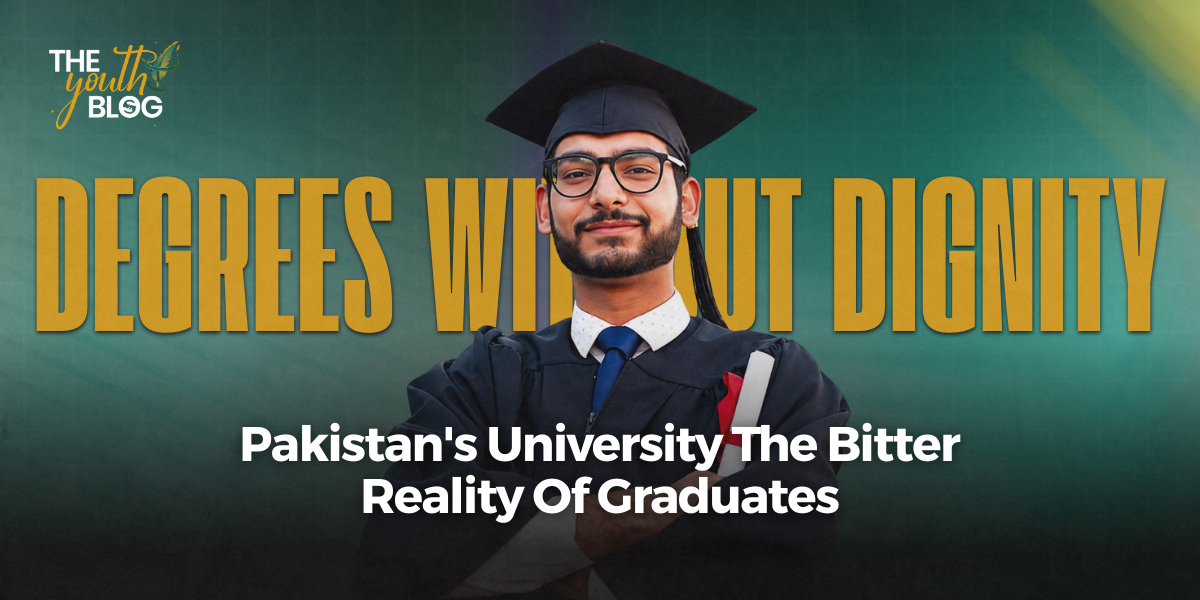
Degrees Without Dignity: The bitter reality of Pakistan’s University Graduates

Whenever I sit through high school career talks or watch elder cousins celebrate their university graduations, I notice standard excitement mixed with a quiet, underlying anxiety. Thousands of young Pakistanis step off campuses holding shiny degree folders, yet within months, many are stuck sending out hundreds of resumes, taking unpaid internships, or wondering why their years
of studying haven’t opened any real doors. At that moment, a question repeatedly arises in my mind: why are so many educated young people in my country struggling to find direction or meaningful work?
Higher education in Pakistan has expanded rapidly, but the real value of that education feels like it is shrinking. While universities continue to function like assembly lines printing degrees, they have largely stopped teaching students how to think for themselves.
“Degrees without dignity” has become a quiet reality taking over our future.
A Paper Promise: The Graduate Crisis
Data from the Pakistan Institute of Development Economics (PIDE) and national labor reports show that unemployment among university graduates is actually much higher than for people without degrees—around three times higher than the national average. In fact, over 31% of young university graduates in Pakistan remain unemployed or severely underemployed even after completing 16 years of education.
While the Higher Education Commission (HEC) has allowed dozens of new universities and campuses to open, the way students are taught hasn’t updated to match the real world. Classrooms still rely on outdated textbooks, memorization-based tests, and commercialized degree programs that don’t prepare students for modern jobs. This hits young people hard: families often spend their life savings on university tuition, expecting a secure future, only to find out that the degree alone doesn’t guarantee practical skills or job security.
Killers of Curiosity: How Rote Learning Traps Youth
The bigger problem hiding behind these employment statistics is what happens to a student’s mind during their university years. Employer surveys across Pakistan reveal that nearly 72% of companies are dissatisfied with fresh graduates, reporting that entry-level job applicants lack basic problem-solving abilities, written communication, and critical thinking.
Instead of encouraging students to ask hard questions, debate ideas, or solve complex real-world challenges, the academic system heavily rewards “Ratta culture”—memorizing lecture notes word-for-word just to clear semester exams. When grading relies on compliance rather than originality, students lose their intellectual curiosity and self-confidence. Trapped in a routine that prioritizes GPA over genuine capability, an entire generation enters adulthood feeling unprepared and burnt out.
Degrees for Sale: The Illusion of Qualification
It is easy to see why so many high schoolers and teenagers look up to university degrees as an automatic ticket to success. We are taught from a young age that a degree equals respectability. However, the day-to-day reality of higher education often falls short of that promise. Final-year research projects are frequently copy-pasted from old reports, exams measure memory instead of application, and attendance sheets matter more than actual understanding.
While a few self-taught individuals manage to learn programming, graphic design, or online skills on their own outside of class, the average student is left behind. Universities shouldn’t just be credential factories; they should be active launchpads where young people learn to build projects, create
jobs, and think critically about the world around them.
The Skill Gap: Why Credentials Don’t Equal Capability
When society praises academic credentials without looking at what a student actually knows how to do, we accidentally keep a broken system alive. Because family members, neighbors, and employers often judge intelligence by a university’s name or a piece of paper, degree mills and subpar programs continue to thrive. Giving blind respect to formal titles—even with good
intentions—makes people ignore practical skills, vocational training, and creative talent. As long as we value the label over the actual ability, vulnerable students will keep spending time and money on degrees that leave them feeling stranded.
Read More: Beyond Borders: Why Pakistani Youth Seeks Opportunities Abroad
Fixing the System: Action Plan for Real Change
To fix the broken link between university degrees and real-world success, concrete changes need to happen at every level of society:
Government & HEC Level:
● Modernize the Curriculum: Replace pure memory-based exams with project-based learning, practical problem-solving, and tech-driven skills.
● Link Classrooms to Industries: Make structured internships and co-op programs mandatory so students gain actual work experience before graduating.
● Strict Quality Checks: Stop approving low-quality university campuses that operate like businesses without providing proper faculty or infrastructure.
● Support Youth Startups: Invest in university incubators, tech labs, and startup grants so graduates can create jobs instead of just looking for them.
University & Teacher Level:
● Encourage Classroom Discussion: Shift from lecture-only teaching to open debates, group case studies, and hands-on workshops.
● Train the Faculty: Give professors continuous training on modern teaching methods so they mentor students rather than just reading off slides.
● Practical Career Guidance: Set up active career centers that teach resume writing, interview preparation, soft skills, and networking early in college.
Social and Family level:
● Respect Vocational & Technical Paths: Normalize skill-based learning, trade schools, and freelancing as respected alternatives to traditional 4-year degrees.
● Focus on Skills Over Marks: Evaluate young people based on their creativity, portfolio, and problem-solving skills rather than just their final GPA.
Conclusion
At last, genuine capability and the ability to think critically are worth far more than a sheet of paper. The confidence that comes from mastering a real skill brings much more self-respect than a degree that leaves you unprepared for life. Higher education should never be a passive four-year routine—especially today, when the world changes faster than ever. Through real academic reforms, practical training, and a society that values actual skill over titles, we can give young Pakistanis a clear path to self-reliance. By raising thinkers instead of just test-takers, we can build a future built on hard work, innovation, and genuine dignity.
Laksh is an A-levels student from Hyderabad, aiming to pursue studies in Computer Sciences.