Who Built a Pakistan Without Ramps?

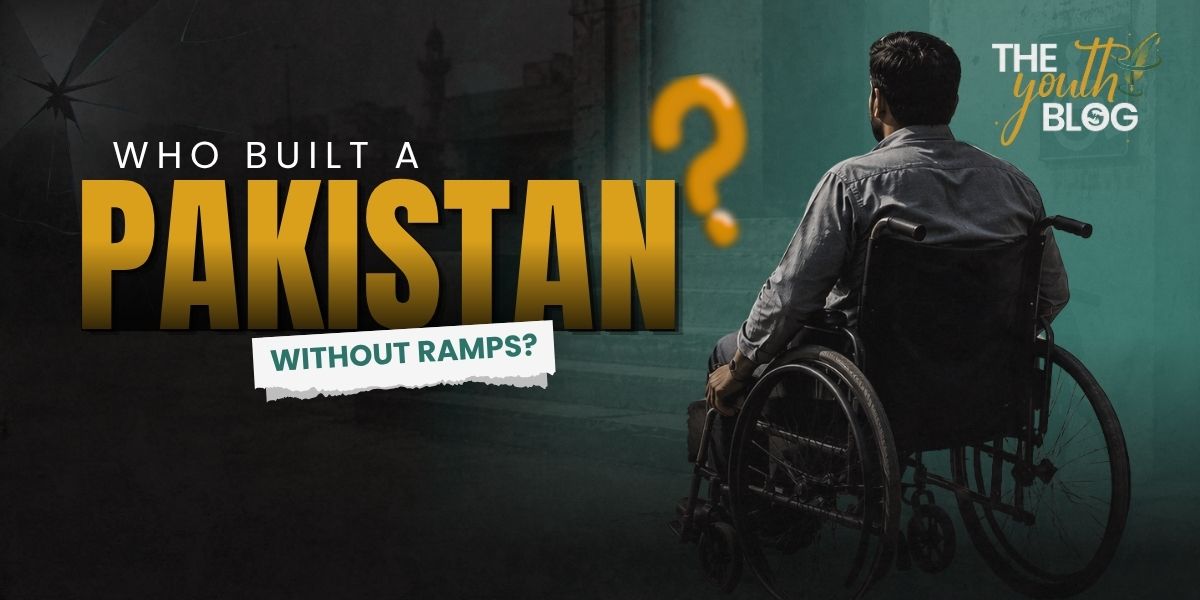
On paper, Pakistan looks like a country that has taken disability rights seriously. Provincial laws mandated a 2% employment quota for persons with disabilities in public sector jobs. There are accessibility guidelines for public buildings, a national policy framework, and periodic government announcements about inclusion. Step outside the paperwork, though, and the picture
changes fast into a country where a wheelchair user in Lahore still cannot always find a shop with a ramp, and where a child with a visible disability is more likely to be kept home than enrolled in school.
The Gap Between the Law and the Sidewalk
Tanzila Khan, a Lahore-based entrepreneur, author, and disability rights activist who has used a wheelchair since birth, has spent years describing this gap in plain terms. In an interview with the Open Society Foundations, she said that even in the most educated circles, people are often too uncertain to know how to talk to her. That discomfort isn’t just social awkwardness it shapes hiring decisions, classroom placements, and whether a disabled person is treated as a full participant in public life or as someone to be managed at a distance.

The isolation Khan describes isn’t abstract. In 2019 she launched Girlythings.pk, an app that discreetly delivers menstrual and maternity products to women across Pakistan, after she was unable to find a single shop with wheelchair access to buy sanitary products in her own city. A basic errand that most people complete without a second thought had become, for her, a logistical
barrier significant enough to build an entire company around solving it. Her experience is not unusual; it’s representative of how Pakistan’s infrastructure quietly assumes that disabled bodies simply won’t be the ones using it.
Public transport compounds the problem. Buses rarely accommodate anyone who cannot climb unassisted, and the paratransit options that do exist are concentrated in a handful of major cities. Schools that describe themselves as inclusive frequently lack trained staff, adapted materials, or something as basic as a working ramp meaning that even families who want to keep a disabled child in mainstream education often find the system unequipped to support that choice.
A Culture That Treats Disability as Private Shame
Muniba Mazari, an artist and UN Women Goodwill Ambassador who became paraplegic after a car accident at 21, has spoken about wanting a world where her life is more about who she is and less about the wheelchair she uses. That distinction between disability as an identity imposed from outside and disability as one fact among many about a person is exactly what much of Pakistani society still struggles to make. Disability is often treated as a private family matter to be managed quietly rather than a
public responsibility that infrastructure and institutions should be built around.

This cultural framing has concrete consequences. Children with visible disabilities are sometimes pulled out of school not because there’s no space for them, but because parents fear judgment from relatives and neighbors. Adults with disabilities are frequently underemployed not for lack of skill or ambition, but because employers assume incapability before they’ve even asked a single
question about someone’s actual abilities. In rural areas, disability is sometimes still framed as misfortune or omen rather than a medical reality, deepening the isolation of people who are already navigating a world not designed for them.
The Advocates Closing the Gap
None of this is happening without resistance. Abia Akram, founder of the National Forum of Women with Disabilities in Pakistan and one of the BBC’s 100 Women in 2021, has spent years pushing disability rights into policy conversations at both the national and regional level. Abid Lashari, who lost both hands in a childhood fire, founded the National Disability & Development Forum, which now runs rehabilitation centers across Sindh. These are not isolated success stories; they represent a growing, disability-led movement that is increasingly setting up the agenda rather than waiting to be included in someone else’s.
What’s still missing is enforcement. Employment quotas exist on paper but go largely unmonitored. Accessibility guidelines exist without inspection regimes to back them up. The distance between what Pakistan’s laws promise and what its cities, schools, and workplaces deliver is where millions of disabled Pakistanis are left waiting.
What Closing the Gap Would Require
Real progress here doesn’t need another awareness campaign. Pakistan already has plenty of goodwill and sympathy toward disability as a cause. What it needs is enforcement: audits of the employment quota with real consequences for noncompliance, accessibility requirements tied to building permits rather than treated as optional guidance, and teacher training that makes inclusive education more than a slogan on a school’s website.
Tanzila Khan didn’t wait for the country to become accessible before building something to solve her own problem, and that entrepreneurial instinct is admirable. But no country should require its disabled citizens to individually engineer around barriers the state was supposed to remove in the first place. Until enforcement catches up to legislation, Pakistan will keep producing remarkable individual advocates while the everyday infrastructure of the country continues to be built as
though disabled people were the exception rather than a permanent and sizable part of the public it serves.
Eman Kashif is a Media and Communication Studies student at the University of Home Economics, Lahore. She writes articles for magazine and blog writing competitions, and has recently won a blog competition at the Qasim Ali Shah Foundation, and was also announced as the winner of The Youth Blog’s competition 2026. By raising awareness on relevant social issues through my blog, she hopes to start conversations that can lead to real change.