Recurring Fear of Floods: Why Pakistan Must Rethink How It Builds

When the 2022 floods finally receded after two months, they left behind the worst disaster impacts in Pakistan’s recorded history: more than 1,700 people lost their lives and over two million homes were damaged or destroyed. The concrete-block houses were cracked and waterlogged beyond repair, and their owners could do little but wait for the government to give
them a chance to rebuild not just the structures, but their lives.
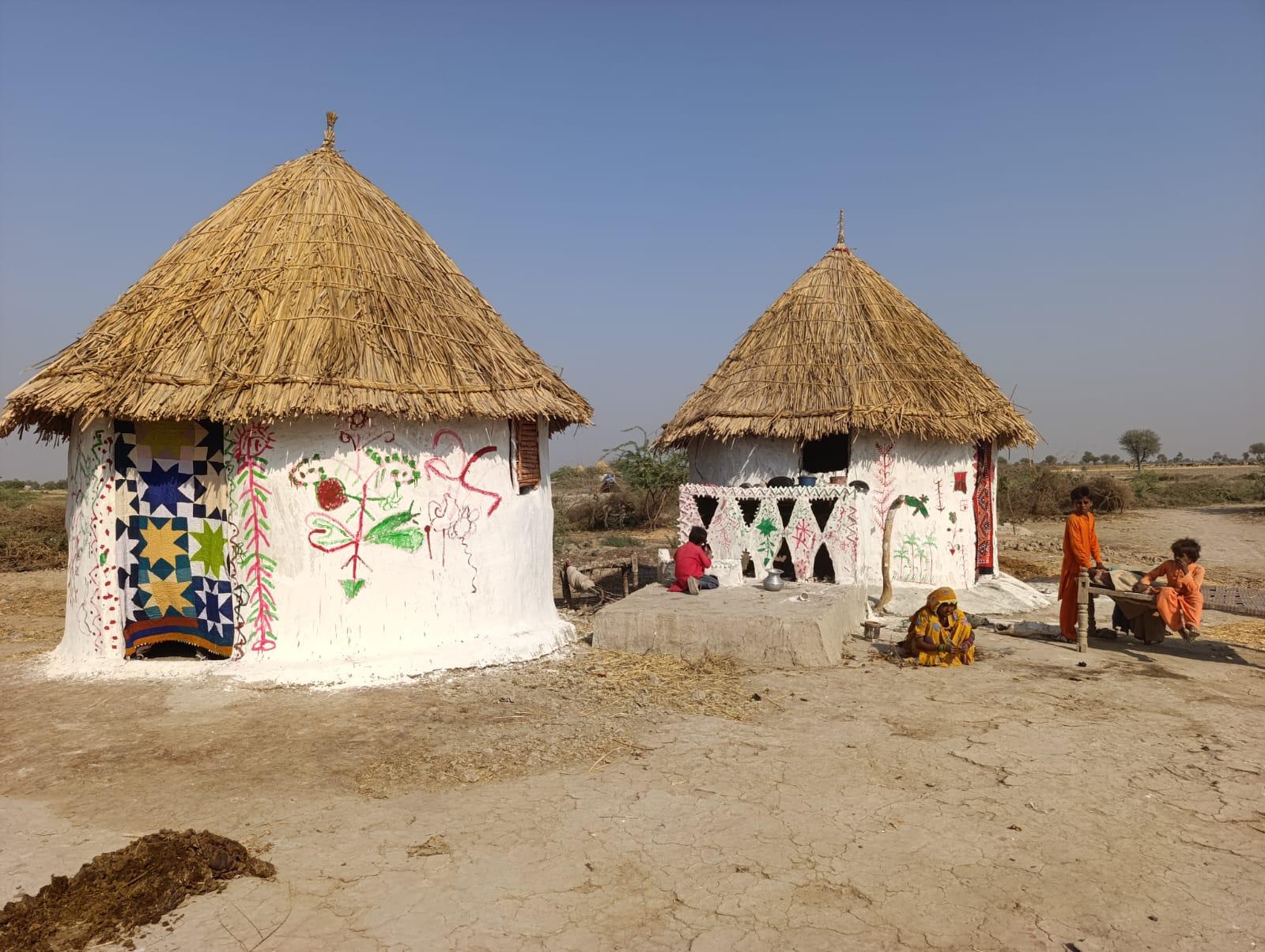
Meanwhile, a kind of rebuilding was already underway: the Heritage Foundation of Pakistan, founded by the architect Yasmeen Lari, was helping flood-hit families across interior Sindh build one-room octagonal homes from mud and lime plaster on bamboo frames. The materials came from the surrounding land, and the families built the houses themselves, rather than waiting on
a contractor or a cheque.
In a country battered by floods and heat, concrete is not enough. Concrete and brick are expensive, and can lock families into a cycle of debt and rebuilding. In flood country, resilience cannot just be defined by how hard a building is. It must take into account how the building may fail, how quickly it is able to be rebuilt , and who is the most well-equipped to fix it. Utilizing local,
low-carbon materials that perform well on all three frontiers would not only benefit homeowners, but stop billions from being spent on materials that feed the emissions, which drive the floods in the first place.
The carbon cost of reconstruction matters, it is that which determines the sustainability of a solution. The cement industry is responsible for roughly 8% of global CO2 emissions, and coal-fired brick kilns account for up to 91% of particulate matter emissions in some South Asian cities. Burning fossil fuels and manufacturing cement warm the atmosphere and cause heavier
monsoon rainfall. Therefore, rebuilding with carbon-heavy compounds makes this solution self-defeating.
The burden of this cycle falls unevenly. Pakistan produces less than 1% of global greenhouse gas, but has absorbed tens of billions of dollars in damage due to emissions driven largely by the global north. The countries that built their wealth on carbon heavy industries send the bill to the flood exposed regions that emit the least. Asking flood-hit families to rebuild with carbon
intensive materials funded by external aid compounds that injustice. Bamboo offers a cheap, lower-carbon alternative. It has a higher tensile strength-to-weight ratio than steel, and is lighter than most conventional construction materials. It has a lower cost in construction and transportation, offering an eco-friendly, cost-effective alternative.
Read More: Why Pakistan’s Disaster Financing Must Put Women At Center Of Recovery
Sindh’s climate asks two things of a house: that it survives water and survives intense waves of heat. Concrete, once cured, is rigid and impermeable. It blocks natural water flow, worsening local erosion and flash flood severity. Concrete blocks are also porous, so after a flood, it can sponge up contaminated floodwater. The walls stay damp, forming hazardous mold, and the moisture corrodes steel reinforcements causing structural cracking. It also has a high volumetric heat capacity, so concrete slabs and walls absorb solar radiation all day and release it overnight. Interiors stay hot long after sunset in a province that is already among the hottest places on earth, and summer temperatures can go upwards of 45°C. Where these buildings cluster, temperatures rise due to the heat island effect.
Earth offers a low carbon alternative. Thick mud walls have superior thermal lag: heat takes approximately 6-10 hours to pass through standard compressed stabilised earth blocks (CSEB), while taking 4-8 hours to pass through concrete. In mud walls heat only reaches the interior after the outside air has cooled. It keeps indoor temperature stable through the day, and keeps
relative humidity balanced. Having lightweight, well insulated roofs made of bamboo avoids the heat that heavy concrete roof slabs radiate, providing better thermal regulation.
The best solution may not have to be one we import, but what we can find in our own land. The materials that can keep a house standing through floods and heat (earth, lime, bamboo) are already in Sindh. In the Sahel, the Nubian Vault Association builds earth roofs on a 3,000 year old design that keeps homes markedly cooler than the tin roofs they replaced. The same
principle applies in Sindh’s heat, and Yasmeen Lari’s houses add what the mud huts that washed away lacked: a raised platform, lime-hardened walls and a layered roof built to shed water. Her Heritage foundation says this model costs one-fifth of conventional high-carbon construction, and the carbon savings are just as steep. An independent study of CSEB in Nepal found they emit 75–78% less CO2 per kilogram than fired brick. Lari’s walls use mud and lime, and lime re-absorbs CO2 as it hardens. Rizq’s Zero Carbon Community in Mirpurkhas shows the approach working on the ground, helping build climate resilient housing for 250
flood-affected households, at a lower cost and lower carbon emissions.
The case against mud is not baseless. Sindh’s own housing foundation found that 75% of the 2 million homes washed away in the province were made of mud, and it now wants to rebuild with burnt brick and cement instead. A World Bank spokeswoman has said permanent brick-and-mortar houses are better able to withstand disasters than mud-based ones. They are
right about one thing: plain mud does not survive weeks of standing water, and untreated bamboo rots.
However, the failure of this is not in the vernacular material, but in the design. Mud blocks can be just as stable as more modern masonry when it is raised on a stone platform, stabilised with lime and sealed against water. Lari’s Barefoot Social Architecture uses prefabricated, cross-braced bamboo frames filled with mud and finished in lime-hardened plaster, and it has helped build tens of thousands of homes. No material fully survives a flood’s direct path. What matters is whether a home can be repaired quickly, cheaply and by the people who live in it.
For this reason, the upkeep stabilised earth requires is an economic feature, not a flaw. Concrete ties impoverished communities to expensive industrial supply chains in a cycle of dependency they cannot afford once aid crews leave. Local mud and lime return economic power back to the community and create local masonry jobs. Concrete is only ‘low maintenance until it cracks from soil shifting during monsoons, at which point it is incredibly expensive for a low-income family to repair.
A common objection is that promoting reconstruction with mud for flood-affected communities reinforces inequality, questioning why poorer rural populations should be relegated to earth, while the wealthy enjoy the security and status symbol of concrete. However this argument misidentifies the problem: it is the stigma itself, not the material, that entrenches the class
divide. This equation of modernity with carbon-heavy industrial materials is a colonial and corporate construct. It devalues local materials and knowledge in favour of imported, industrialized products, trapping vulnerable communities in a cycle of economic dependency to pay for them. For decades, this material hierarchy has been reinforced by international aid agencies and building codes pushing concrete blocks as a default, systemically depleting local craftsmanship. A home built from local materials and knowledge is not an inferior compromise.
Reinforced with modern engineering principles, vernacular architecture can be a high-performance, climate-resilient structure.
Pakistan’s disaster financing frameworks require a shift in policy and in mindset. Success should not be measured by how many houses are built, but by how much capacity is left within the community: the skilled local builders, and the household knowledge that let families repair and rebuild without waiting on outside help. A programme delivering tens of thousands of houses but leaves families dependent on contractors has built shelter, not resilience.
Reconstruction funding should recognise and certify vernacular and hybrid low-carbon construction as “resilient housing,” so it qualifies for the grants, subsidies and legitimacy currently reserved for concrete.
Funding should follow the method. Instead of importing elite urban contractors, we should finance localised training pipelines that certify rural Sindh’s own builders in flood-resilient vernacular engineering, certifying local artisans in modern stabilisation techniques. Funding should directly subsidise local materials like bamboo and earth, rather than cement. Where a
house cannot hold, it should fail safely, and the people who live in it should be able to repair it. Because the materials and knowledge remain entirely within the community, the people who live in it can repair it without falling into a cycle of debt. A house does not need to be indestructible to be resilient. It needs to be repairable, affordable, and ours.
In 2022, families waited for someone else to rebuild their homes. The next time the water rises, they should be able to rebuild them themselves.
Fatima Soomro is an A-levels student, aiming to major in Mathematics. Beyond academics, she has a passion for developing innovative, sustainable and eco-friendly solutions to hunger, poverty and unemployment.